


Learners decide. AI builds. Real people judge.
One framework runs every Arena School program, for students, teachers, school leaders, and parents. Here is what learners practice, what they can do by the end, and how we know.
One framework, every program.
The learner sits at the center. Four strands of work circle them. Four teaching principles hold it in place.
- Inquiry and planningTurn an interest into a focused question, and plan the work.
- Research and evaluationCheck sources, including AI output, and choose on evidence.
- Creating and communicatingBuild and test it with AI, and explain it clearly.
- Collaboration and reflectionUse critique from teachers and peers to revise the work.
- In person, real-time feedback
- AI use disclosed and cited
- Learner voice and choice
- An authentic audience
The question at every check-inHow did you check it?
We say learner on purpose: the same framework runs our student programs, our teacher training, and our sessions for school leaders and parents. Built on project-based learning and informed by PBLWorks’ Gold Standard PBL. AI can support the feedback. It does not replace it.
Five days, all four strands.
A five-day student build week, as run at the International School of Beijing in summer 2026. Darker blocks show the day each strand is practiced.
| Strand | Day 1Pick a problem | Day 2Go public | Day 3The rebuild | Day 4Polish and price | Day 5Demo day | Evidence |
|---|---|---|---|---|---|---|
| 01Inquiry and planningTurn an interest into a focused questionDay 1 | Day 1Pick a problem and a plan | EvidenceA plan and a first prototype | ||||
| 02Research and evaluationCheck sources, including AI outputDays 1 to 3 | Day 1In progressDay 2Test it with the people it’s forDay 3In progress | EvidenceChoices backed by what users did | ||||
| 03Creating and communicatingBuild and test a product with AIDays 2 to 4 | Day 2Ship itDay 3In progressDay 4Price it | EvidenceA live product at a public link | ||||
| 04Collaboration and reflectionUse critique to revise the workDays 3 to 5 | Day 3Rebuild itDay 4In progressDay 5Defend it | EvidenceA rebuilt product, and a pitch to judges | ||||
No worksheet, no quiz. The work is the evidence.See the five-day Entrepreneurship & AI Intensive →
Outcomes you can assess on any project.
The same outcomes hold for every learner. The depth grows, from middle school to adults.
Inquiry and planning
- Turn a broad interest into a focused, researchable question.
- Plan a project with milestones, and adjust the plan based on progress.
Research and evaluation
- Find, evaluate, and cite sources, including checking the accuracy of AI output.
- Compare options against criteria, and justify a choice.
- Explain how AI tools work, where they fail, and the bias and privacy issues they raise.
Creating and communicating
- Build and test a product, prototype, or solution, deciding which steps to hand to AI and disclosing how they used it.
- Structure an argument and write it clearly, in their own words.
- Present to an authentic audience, and defend their reasoning under questioning.
Collaboration and reflection
- Work in a team, share roles, and contribute to a shared product.
- Give and use critique from teachers and peers to revise their work.
- Reflect on their process and on what they would do differently.
We assess the thinking behind the work.
The process, not only the product: how a learner chose, checked, and finished.
Evaluates sources, including AI output
- BeginningAccepts sources and AI output as given; cites inconsistently.
- DevelopingChecks some claims against a second source; cites most sources.
- ProficientVerifies key claims, including AI output, against reliable sources; discloses AI use.
- ExtendingExplains why sources disagree, corrects AI errors, and judges which evidence to trust.
Used with students in the ISB AI Founders Program, summer 2026. With a school, the rubrics stay with its team.
- Process journal
- Drafts
- Recorded defense
- Agency
Why this problem?
- Taste
How do you know it’s good?
- Craft
What would make someone trust it?
The skills and principles behind the framework.
Our approach explains why agency, taste, and craft come first, the principles in every room, and how the framework fits students, teachers, schools, and families.
- Three skills
- How we teach
- Who does what
- By audience
See it in a program.
From two-day workshops to year-long mentorship, every Arena School program runs on this framework.
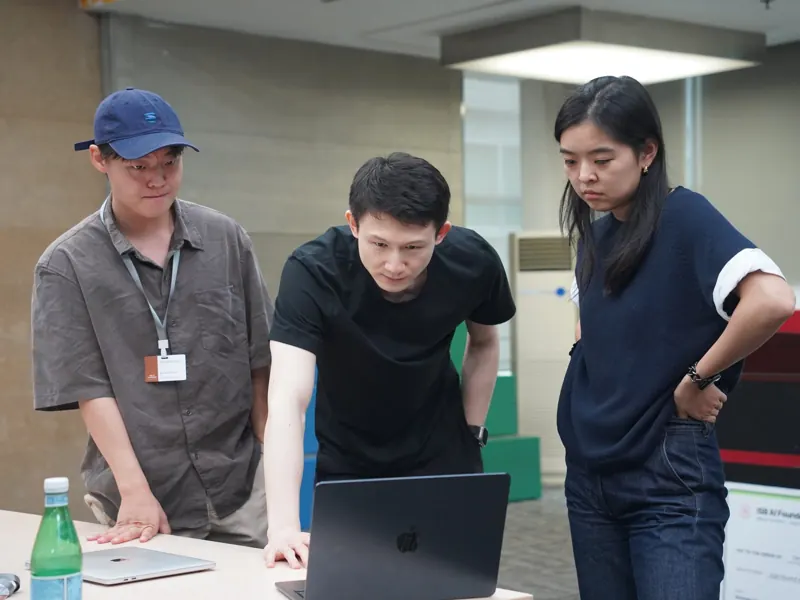
 Judges test each product before scoring, Beijing 2026