Our approach

Agency, taste, and craft.

When AI can make almost anything, learners need to know what is worth making, whether it is good, and how to finish it.

Three skills

What AI cannot do for them.

Each skill gets a moment in every program that learners cannot skip.

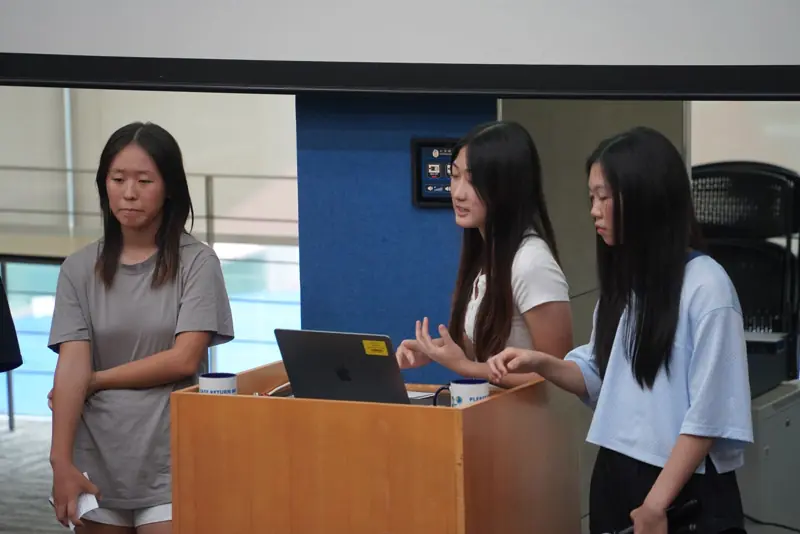
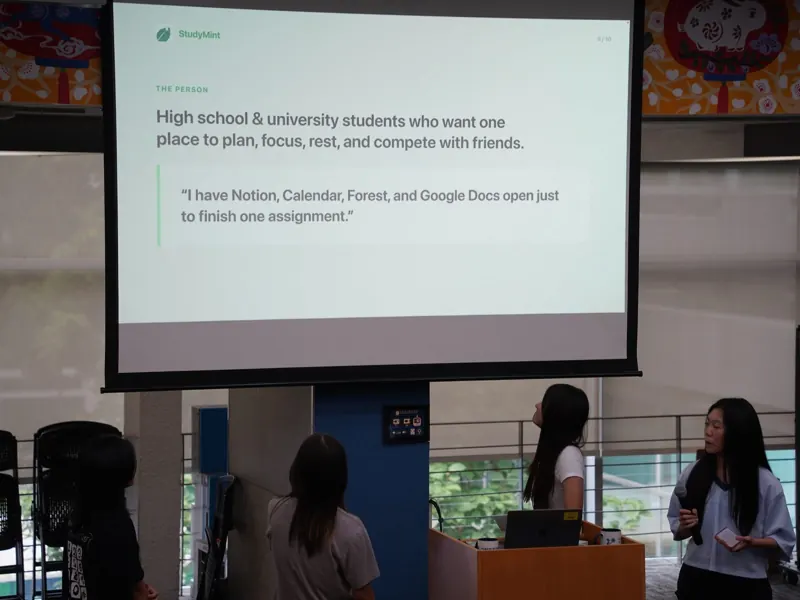
A team presents the problem it chose to solveI

Agency

Choose what is worth doing, before anyone assigns it.

How learners practice it
Each learner chooses the problem and pitches it in three minutes, with no slides.
Without it
AI picks the problem, and the learner follows.
What it changes
  1. In schoolWhen AI can finish the assignment, the harder skill is setting the question.
  2. At workWork that only follows instructions is the easiest to hand to AI. People who define the problem direct the work.
  3. Over a careerA project a learner chose and saw through shows initiative a transcript cannot.

Mentors respond to a student’s workII

Taste

Judge whether the work is actually good.

How learners practice it
A working version goes live at a public link, and real users and mentors react every day.
Without it
The first answer AI gives becomes the final one.
What it changes
  1. In schoolWhen every essay can look polished, telling strong work from weak is what teachers need to see.
  2. At workA team can generate ten versions in an hour. The person who picks the right one, and says why, is the one they rely on.
  3. Over a careerJudgment compounds. It earns trust with larger decisions.
Students present a finished productIII

Craft

Finish the work so people can trust it.

How learners practice it
Building stops at a fixed hour, and on demo day learners explain every decision live.
Without it
The work stays an unchecked first draft.
What it changes
  1. In schoolA first draft is now instant. Revising it into something reliable is where the learning happens.
  2. At workA working product earns trust that a prototype or a slide deck does not.
  3. Over a careerA record of finished work, with a live link, speaks for itself.
Principles

How we teach.

Four principles in every room, a clear split of the work, and a day with the same shape every time.

  1. In person, real-time feedback

    Mentors sit with learners while they build, ask how they checked it, and respond on the spot.

  2. AI use disclosed and cited

    Learners decide which steps to hand to AI, and say how they used it. Student data stays in accounts the school approves.

  3. Learner voice and choice

    Learners choose the problem. Mentors support. They do not assign.

  4. An authentic audience

    Work goes in front of real users, judges, and families.

Who does what
AI tools and mentors handle
  • Writing the code
  • Putting it online
  • Fixing technical errors
Learners decide
  • Which problem, and for whom
  • What to cut after users try it
  • The name, the price, and the pitch
Eight principles, grouped by skill
Agency
  1. IAgency from day one.Mentors support; learners choose.
  2. VReflection, started early.Thirty screen-free minutes a day: which of my goals are my own?
  3. VIRisk early, while it’s cheap.Small, repeated risks make larger ones easier.
Taste
  1. IIMake things in front of people.Every day ends with a demo.
  2. IIIExperienced mentors in the room.Founders, engineers, and designers who have made real products.
  3. VIIIFirst-principles thinking.How, why, what principle, when it fails, and how to adapt.
Craft
  1. IVAI as a partner learners direct.Learners write the prompts, question the output, and check it.
  2. VIIDaily habits, personal systems.Three lines every day: finished, learned, next.
The shape of a day

The same rhythm in every format, from weekend sessions to five-day intensives.

  1. StartLessonTaught right before learners need it.
  2. Most of the dayBuildOn a problem the team chose.
  3. During the buildMentor 1:1sWhen a team is stuck.
  4. Fixed hourThe freezeBuilding stops. Teams demo what works.
  5. DailyReflectionThirty minutes, a notebook, no screens.
  6. End of dayStandupFinished, learned, next.
  7. Last dayDemo dayA live pitch to judges and families.
By audience

Same framework, four kinds of learner.

The goals hold. The project, the depth, and the format change.

Grades 6 to 12, plus college and early career. Every program ends in something real, made in front of real people.

  • Two days at school · Grades 6 to 9

    App Design Workshop

    • Learn how software is made by taking a familiar app apart.
    • Direct AI coding tools, then test and judge the results.
    • Publish an app, and build the next tool for a hobby, a club, or a class.
    See the program →
  • Two days at school · Grades 10 to 12

    College Portfolio Workshop

    • Judge which of their own work best represents them.
    • Plan, write, and design a real site. Every word stays theirs.
    • Use it for college, summer program, scholarship, and internship applications.
    See the program →
  • Five days at school · Grades 7 to 12

    Entrepreneurship & AI Intensive

    • Choose a real problem, talk to users, set a price, and pitch to a panel.
    • Use AI for research, building, and the brand, and decide what stays.
    • Carry the same steps into a passion project, a competition, or a class.
    See the program →
  • 1:1, six months to a year · Grades 7 to 12

    Year-Long Project Mentorship

    • Choose the problem and answer for the results.
    • Put the product in front of real users.
    • Take it past a first draft: test it, revise it, make it good.
    See the program →
  • Four days, winter break

    AI Fundamentals for Students @ International School of Beijing

    • Learn AI tools for research, design, code, and video on their own project.
    • Choose a project worth making. Every decision stays theirs.
    • Finish a working version anyone can open, tested with real people.
    See the program →
  • Seven days · College and early career

    AI Advantage Bootcamp

    • Launch a live AI product with real users.
    • Build a project for the role they want, and a portfolio.
    • Present the work on stage at demo day.
    See the program →
Next: the framework

What learners practice, and how we know.

The learning approach sets out the framework behind every program: four strands with their learning goals, a worked week, the outcomes, and how we assess the thinking.

  • The framework wheel
  • A worked week
  • Outcomes by strand
  • How we assess
Read the learning approach →
Next step

See it in a program.

From two-day workshops to year-long mentorship, every Arena School program runs on this framework.

Judges test a student product before scoring
Judges test each product before scoring, Beijing 2026