


College Portfolio Workshop
A two-day workshop at your school. Students judge which of their own work best represents them, then build a website to link in college, summer, and scholarship applications.
- Grades10 to 12
- LengthTwo days
- WhereAt your school
- Students makeA portfolio website
- CodingNone needed
- LanguageEnglish or Chinese
Show the work, not a description of it.
Grades 10 to 12 choose, build, and present a portfolio they can link in every application.
- The gap
Polished essays are now common
With AI’s help, well-written descriptions are easy to produce.
How the workshop closes itShow the work itself
Projects, research, and awards go where a reader can open them, not just read about them.
- The gap
Too much to show, no order
Students rarely decide what represents them best.
How the workshop closes itChoose what to show
Students select their work, decide the order, and write one line on who they are.
- The gap
AI drafts that do not sound like them
Generated text can blur who the student is.
How the workshop closes itEvery word stays theirs
AI tools help draft and build; students choose, order, and explain their own work.
- The gap
One application at a time
Each new application starts from a blank page.
How the workshop closes itOne site, many uses
The same site serves college, summer program, scholarship, and internship applications.
With AI’s help, polished essays are now common. A portfolio shows the work behind it.
A portfolio shows the work itself, not a description of it. Building one hands-on, students learn how a website is made, how to use the new tools, and how to present their work wherever it matters.
Common App end-of-season report, 2025–26: 10.8 million first-year applications, up 6% in a year.
How a website is made
Students plan the structure, write, and design a real site, putting projects, research, and awards where a reader can open them.
Using the new tools well
AI tools help draft and build. Students choose, order, and explain their own work, and every word stays theirs.
One skill, many uses
The same site serves college, summer program, scholarship, and internship applications, and students can build the next one for a club or class project.
 ChatGPT
 Claude
 Kimi
 Figma
 Canva
 Notion
 GitHub
 Vercel
Students use AI. Few are taught to use it well.
Three findings from RAND’s national surveys of students. Each links to its source.
- 54%
of U.S. students said they used AI for school in 2025, up more than 15 points in one to two years.
Source: RAND, AI Use in Schools Is Quickly Increasing but Guidance Lags Behind, September 2025
- 80%+
of students said their teachers did not explicitly teach them how to use AI for schoolwork.
Source: RAND, AI Use in Schools Is Quickly Increasing but Guidance Lags Behind, September 2025
- 1 in 2
students said they are worried they will be falsely accused of using AI to cheat.
Source: RAND, AI Use in Schools Is Quickly Increasing but Guidance Lags Behind, September 2025
Two days, three steps.
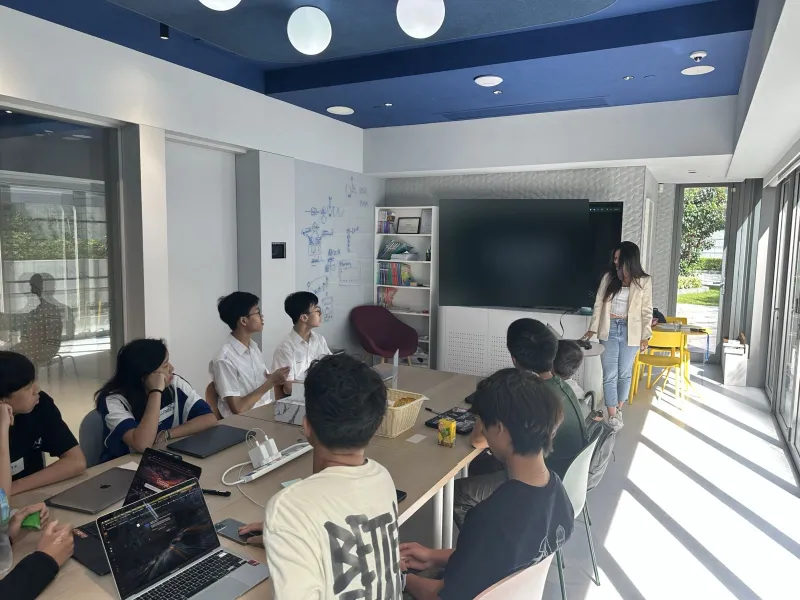

Your teachers and counselors co-run both days with us and keep the materials.
What a finished portfolio can look like.
A sample site made to show the format. Every student’s site is different, because the work and the choices are theirs.

I build low-cost robots to measure plastic on our coastline.
Microplastics on three local beaches
- 8 weeks
- 3 beaches
- 5 depths
- 240 samples
Abstract. Using a low-cost underwater robot, I sampled water at five depths along three beaches over eight weeks.
Key findingParticle counts peak near 12 meters, where currents slow, and are highest at the harbor.


“Clear method, real data, and a tool other schools could build.”Judges’ note
- 2National finalistOcean science competition · 2025Top 20
- ★Summer research scholarshipMarine robotics program · 2024Funded
I grew up by the water and started counting plastic on beach walks. Now I build the tools to measure it properly.
CurrentlyExpanding the survey to five beaches with two classmates.
Dive 07 · 12 m · counting particles near the harbor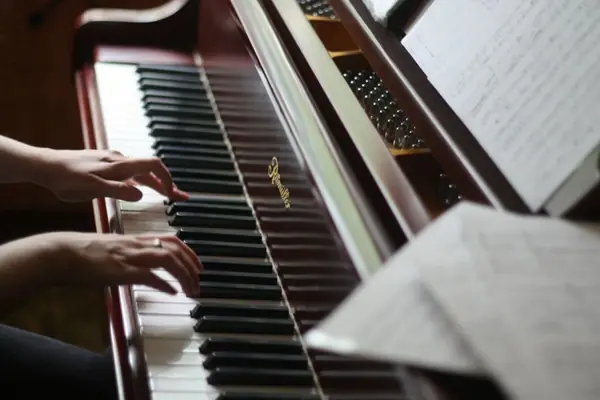

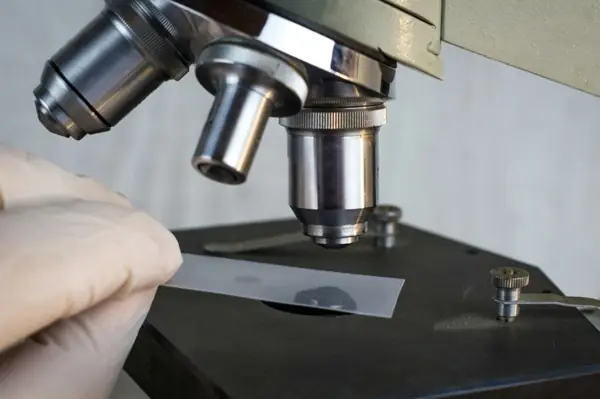
Programs we have run.
- International School of Beijing · Summer 2026
A five-day student program
Over five days, students built working websites and apps with AI and presented them to judges, on the school’s campus with mentors in the room.
- Where
- International School of Beijing
- Judges
- Founders and operators from Harvard, Stanford, Y Combinator, and AI labs
- Bodley Academy · Hong Kong, summer 2025
Twenty students, five days
A five-day course designed and taught by Phillip An. Each student worked on one real problem they chose.
- Students
- 20
- Rating
- 9.5 / 10 Net Promoter Score
- Next · Winter break, Jan 5 to 8, 2027
AI Fundamentals for Students @ International School of Beijing
Four days at the end of winter break. Students learn AI tools and use them to turn an idea into a real product. No STEM background or coding needed.
- Where
- International School of Beijing
 ChatGPT
 Claude
 Kimi
 Figma
 Canva
 GitHub
 Vercel
Or whatever your school approves.
Our team has walked the same path.
Arena’s team studied at and worked for the institutions students aim for, and teaches from that experience.

In her words
Education is moving from knowing the answer to knowing what’s worth building. That is the skill AI can’t hand a student, and the one we teach.
 Jing Jing YangCo-founder, Arena School
Experience
 Brown UniversityEconomics and Behavioral Decision Sciences
 Microsoft AIAI research
 AppleTechnology
 DeloitteConsulting
 Tsinghua UniversitySchwarzman Scholar
 Kimi · Moonshot AIInternational growth
In his words
AI is changing work quickly. The habits students build now, in class and at home, are what carry over.
 Phillip AnCo-founder, Arena School
Experience
 CaltechComputer Science
 McKinsey & CompanyManagement consulting
 Goldman SachsInvestment banking
 Harvard UniversityMBA and master’s in engineering
 Y CombinatorCo-founded Homebase, the first YC-backed company from Vietnam; Forbes 30 Under 30
- Tsinghua UniversitySchwarzman Scholar
Common questions
Do students need to know how to code?
No coding experience is needed. Students describe what they want in plain language, AI coding tools draft it, and students test the result and decide what stays. Directing the tools and judging what they produce is the skill we teach.
Is the portfolio the student’s own work?
Yes. Students choose what to include, write every word, and make the design decisions. AI tools help them build faster and try more layouts; what the site says and shows is theirs.
Where does the link go in an application?
Many applications have room for a link, often in the additional information section. The same site also serves summer program, scholarship, and internship applications. Your counselors advise on what each college accepts.
Will a portfolio improve admission chances?
No one can promise an admissions outcome, and we do not. A portfolio lets readers see the student’s actual work rather than a description of it. Each college makes its own decision.
How much does it cost?
We set it with each school, based on group size, length, and format. Tell us your grades, dates, and number of students, and we will reply within three working days with options.
What does the school provide?
A room, a laptop for each student, and a teacher or counselor who co-runs the days with us. We bring the lesson plan, the materials, and a setup that works with your approved tools.
Bring the workshop to your school
Tell us your grades and preferred dates. We reply within three working days.
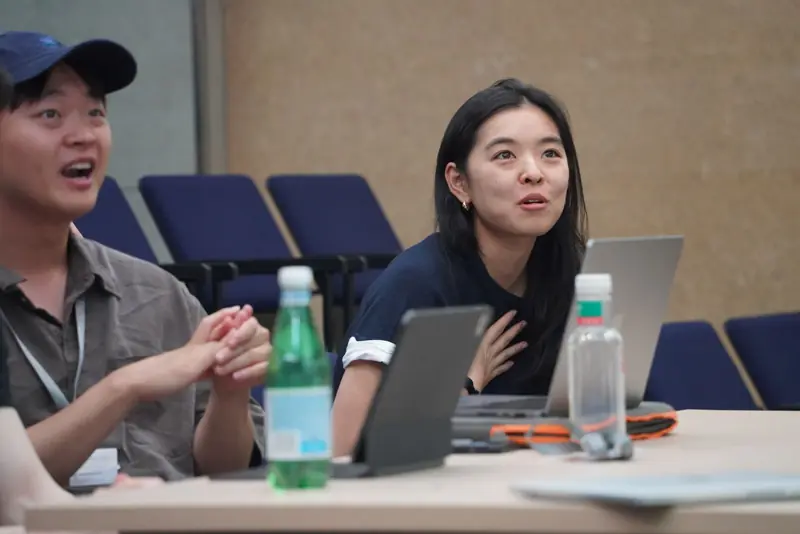
 Mentors respond to a student’s work, Beijing 2026
- 01Spring workshopGrade 11 · two days in March or April
Each student finishes a published portfolio site in time for application season.
- 02Summer workshopRising seniors · two days in June or July
Each student finishes a published site ready before early deadlines.
- 03Weekly sessionsGrades 10 to 12 · four afternoons
The same steps across an elective, club, or advisory block, ending in a published site.
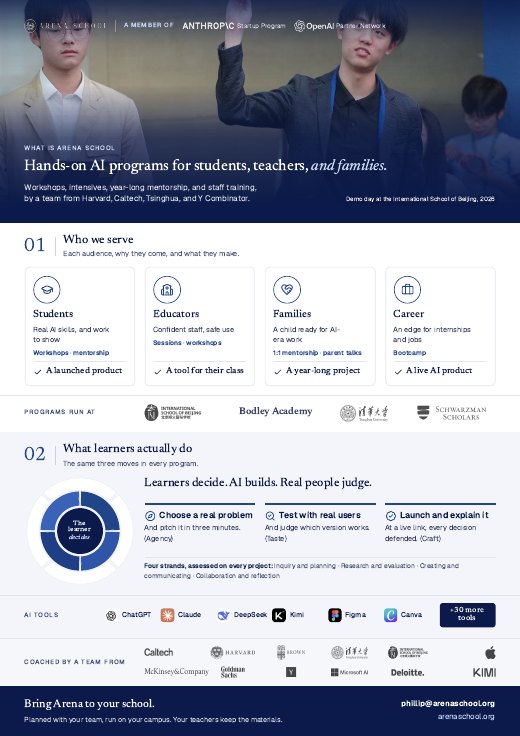
Get the Arena one-pager
Every program and what we have run, on one page for your team or board.
We will email the one-pager to you within one working day.
Our team has your note and will reply personally within three working days.