


App Design Workshop
A two-day program at your school. When AI can build almost any app, students practice the harder part: deciding which one is worth making, then building and publishing their own version.
- Grades6 to 9
- LengthTwo days
- WhereAt your school
- Students makeA published app
- CodingNone needed
- LanguageEnglish or Chinese
From using apps to making one.
Grades 6 to 9 use apps every day. Two days turn that into a first piece of software of their own.
- The gap
Apps feel like magic
Students use them daily without seeing how they are put together.
How the workshop closes itTake an app apart
Students map a familiar app screen by screen and sketch their own version on paper.
- The gap
The first AI draft gets accepted
Coding tools produce something fast, and it is tempting to stop there.
How the workshop closes itDirect, then test
Students direct AI coding tools to build the main feature, then test and judge the result themselves.
- The gap
Nothing to show at the end
Many workshops end with a worksheet.
How the workshop closes itPublish and share
Each student adds a feature the original lacks, tests it with classmates and teachers, and shares a link.
- The gap
A one-off experience
Skills used once fade by the next term.
How the workshop closes itThe next tool, on their own
Students leave able to build the next tool they need for a hobby, a club, or a class assignment.
Making an app is no longer the hard part. Choosing which one deserves to exist still is.
With AI as a helper, students can get a first working version of an app running quickly. Through one hands-on project, students learn how software is made, how to direct the new tools, and how to keep making their own.
How software is made
Taking apart a familiar app shows students why each screen, button, and step earns its place.
Using the new tools well
Students direct AI coding tools, then test and judge the results themselves rather than accept the first draft.
Making their own, next time
Each student publishes an app, and leaves able to build the next tool they need for a hobby, a club, or a class assignment.
 ChatGPT
 Claude
 DeepSeek
 Kimi
 Gemini
 GitHub
 Vercel
 Figma
 Canva
Students use AI. Few are taught to use it well.
Three findings from RAND’s national surveys of students. Each links to its source.
- 54%
of U.S. students said they used AI for school in 2025, up more than 15 points in one to two years.
Source: RAND, AI Use in Schools Is Quickly Increasing but Guidance Lags Behind, September 2025
- 80%+
of students said their teachers did not explicitly teach them how to use AI for schoolwork.
Source: RAND, AI Use in Schools Is Quickly Increasing but Guidance Lags Behind, September 2025
- 1 in 2
students said they are worried they will be falsely accused of using AI to cheat.
Source: RAND, AI Use in Schools Is Quickly Increasing but Guidance Lags Behind, September 2025
Two days, three steps.
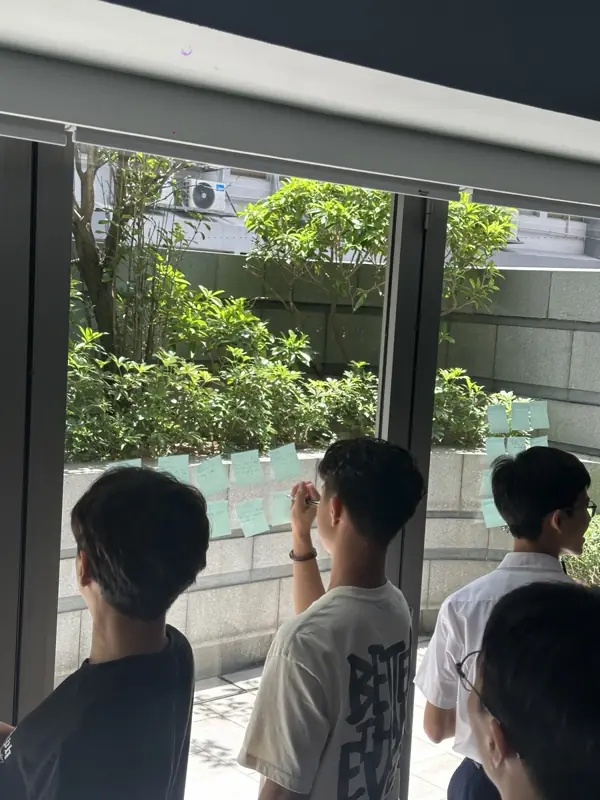
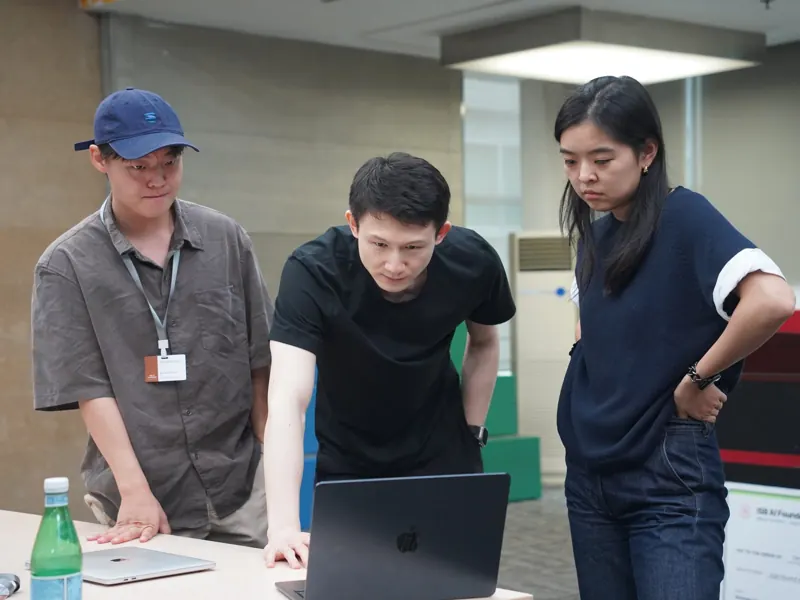
Your teachers co-run both days with us and keep the materials.
Programs we have run.
- Bodley Academy · Hong Kong, summer 2025
Twenty students, five days
A five-day course designed and taught by Phillip An. Each student worked on one real problem they chose.
- Students
- 20
- Rating
- 9.5 / 10 Net Promoter Score
- International School of Beijing · Summer 2026
A five-day student program
Over five days, students built working websites and apps with AI and presented them to judges, on the school’s campus with mentors in the room.
- Where
- International School of Beijing
- Judges
- Founders and operators from Harvard, Stanford, Y Combinator, and AI labs
- Next · Winter break, Jan 5 to 8, 2027
AI Fundamentals for Students @ International School of Beijing
Four days at the end of winter break. Students learn AI tools and use them to turn an idea into a real product. No STEM background or coding needed.
- Where
- International School of Beijing
 ChatGPT
 Claude
 DeepSeek
 Kimi
 Figma
 GitHub
 Vercel
Or whatever your school approves.
Our team has walked the same path.
Arena’s team studied at and worked for the institutions students aim for, and teaches from that experience.

In her words
Education is moving from knowing the answer to knowing what’s worth building. That is the skill AI can’t hand a student, and the one we teach.
 Jing Jing YangCo-founder, Arena School
Experience
 Brown UniversityEconomics and Behavioral Decision Sciences
 Microsoft AIAI research
 AppleTechnology
 DeloitteConsulting
 Tsinghua UniversitySchwarzman Scholar
 Kimi · Moonshot AIInternational growth
In his words
AI is changing work quickly. The habits students build now, in class and at home, are what carry over.
 Phillip AnCo-founder, Arena School
Experience
 CaltechComputer Science
 McKinsey & CompanyManagement consulting
 Goldman SachsInvestment banking
 Harvard UniversityMBA and master’s in engineering
 Y CombinatorCo-founded Homebase, the first YC-backed company from Vietnam; Forbes 30 Under 30
- Tsinghua UniversitySchwarzman Scholar
Common questions
Do students need to know how to code?
No coding experience is needed. Students describe what they want in plain language, AI coding tools draft it, and students test the result and decide what stays. Directing the tools and judging what they produce is the skill we teach.
Is it just a copy of the real app?
No. Students rebuild the core of an app they know to see how it works, then make it their own: a new name, their own design, and a new feature they chose.
Won’t this mean more screen time?
Students plan on paper first and test their app with classmates between builds. The time they do spend on screens goes into making something of their own rather than scrolling.
Which AI tools do students use?
Whichever tools your school approves, including ones that work in China. We teach a method rather than one product, so students can apply it to whatever tools they use next, at school or at home.
How much does it cost?
We set it with each school, based on group size, length, and format. Tell us your grades, dates, and number of students, and we will reply within three working days with options.
What does the school provide?
A room, a laptop for each student, and a teacher who co-runs the days with us. We bring the lesson plan, the materials, and a setup that works with your approved tools.
Bring the course to your school
Tell us your grades and preferred dates. We reply within three working days.
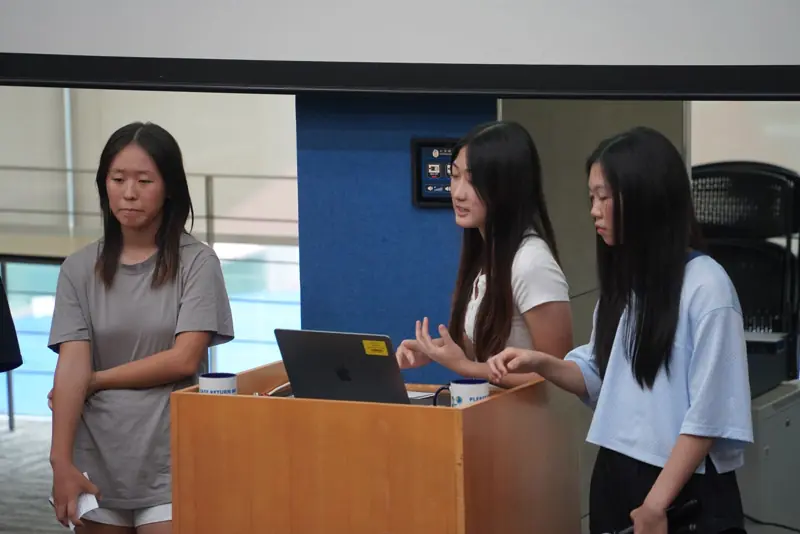
 Students present a finished product, Beijing 2026
- 01Two-day courseGrades 6 to 9 · two school days
The full workshop, taught on consecutive days. Each student builds and publishes their own app.
- 02Activity weekGrades 6 to 9 · two days inside a project week
The same two days, run inside a project or activity week you already schedule.
- 03After-school clubGrades 6 to 9 · four afternoons, about two hours each
The same steps spread across a club block, ending with a published app.
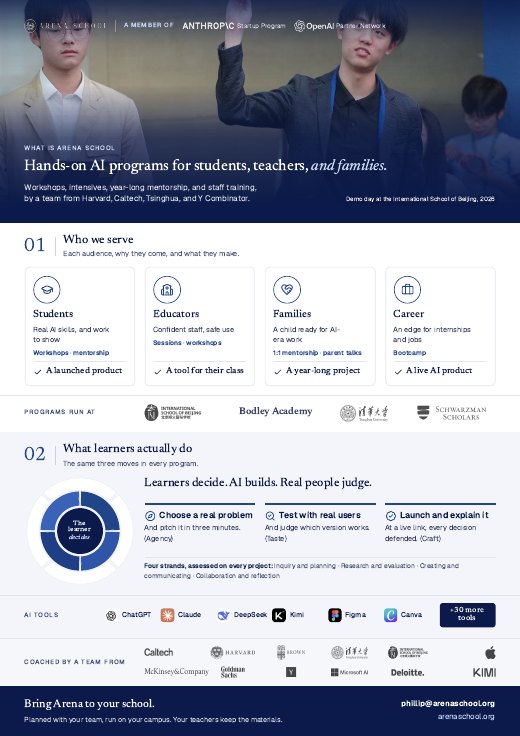
Get the Arena one-pager
Every program and what we have run, on one page for your team or board.
We will email the one-pager to you within one working day.
Our team has your note and will reply personally within three working days.