


Year-Long Project Mentorship
One student, one project they choose, and six months to a year of personalized 1:1 mentorship to build it, grow it, and show it.
- Grades7 to 12
- Length6 months to a year
- Check-insWeekly, 25 min, hybrid
- ProjectSolo or a team of up to 4
- StartRolling
Past the first draft, with someone beside them.
Why one project over six months to a year builds what a short program cannot.
- The gap
Tutoring assigns the task
The student follows a plan someone else wrote.
How mentorship closes itTheir project, their decisions
The student chooses the problem and answers for the results, with a mentor beside them, not in front.
- The gap
Work only teachers see
Feedback comes from people who are paid to be kind.
How mentorship closes itReal users, early
With AI tools, the student builds a working version and shows it to real users early.
- The gap
Short programs end at a first version
Two days is enough to start, not to make it good.
How mentorship closes itWeekly feedback, for months
A 25-minute check-in every week, short written updates between, and a term review with families.
- The gap
Applications need real evidence
A list of activities says little about what a student can do.
How mentorship closes itFive milestones
Launch, traction, revenue, impact, recognition: the same ladder for every project, judged on the work.
When AI can make almost anything, what a student chooses, judges, and finishes sets them apart.
Over one sustained project, students learn how a real product is made, how to use the new tools well, and how to keep making their own, for passions, hobbies, and schoolwork. It also gives a college application real, verifiable evidence of initiative. Admissions decisions rest with each university; we do not promise an outcome.
Their project, their decisions
A tutor assigns tasks. Here, the student chooses the problem and answers for the results, with a mentor beside them, not in front.
Built for real people, not a demo
The product goes in front of real users, not a simulated audience. Mentors have built and launched real products themselves.
Long enough to get past a first draft
A two-day workshop ends at a first version. Six months to a year is enough time to test it, revise it, and make it good.
 ChatGPT
 Claude
 DeepSeek
 Kimi
 Gemini
 GitHub
 Vercel
 Figma
 Canva
Students use AI. Few are taught to use it well.
Three findings from RAND’s national surveys of students. Each links to its source.
- 54%
of U.S. students said they used AI for school in 2025, up more than 15 points in one to two years.
Source: RAND, AI Use in Schools Is Quickly Increasing but Guidance Lags Behind, September 2025
- 80%+
of students said their teachers did not explicitly teach them how to use AI for schoolwork.
Source: RAND, AI Use in Schools Is Quickly Increasing but Guidance Lags Behind, September 2025
- 1 in 2
students said they are worried they will be falsely accused of using AI to cheat.
Source: RAND, AI Use in Schools Is Quickly Increasing but Guidance Lags Behind, September 2025
Four phases, one project, at the student’s own pace.
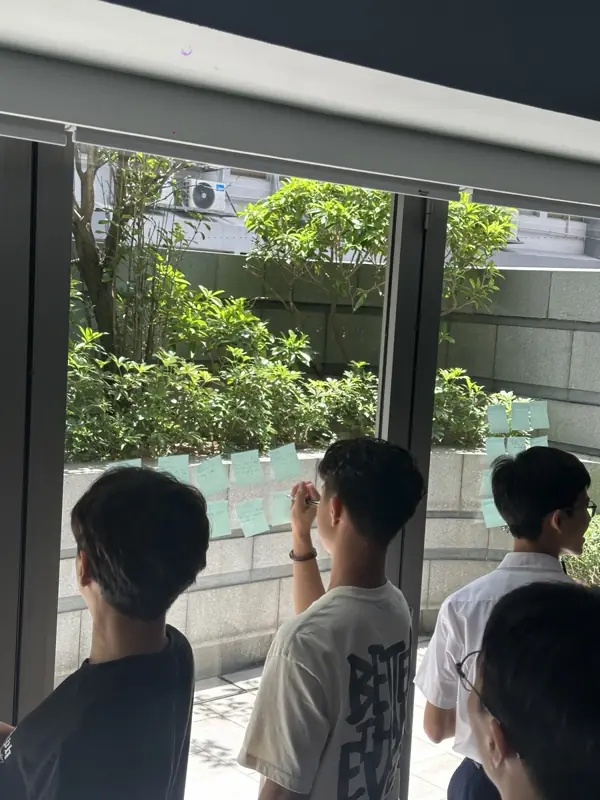
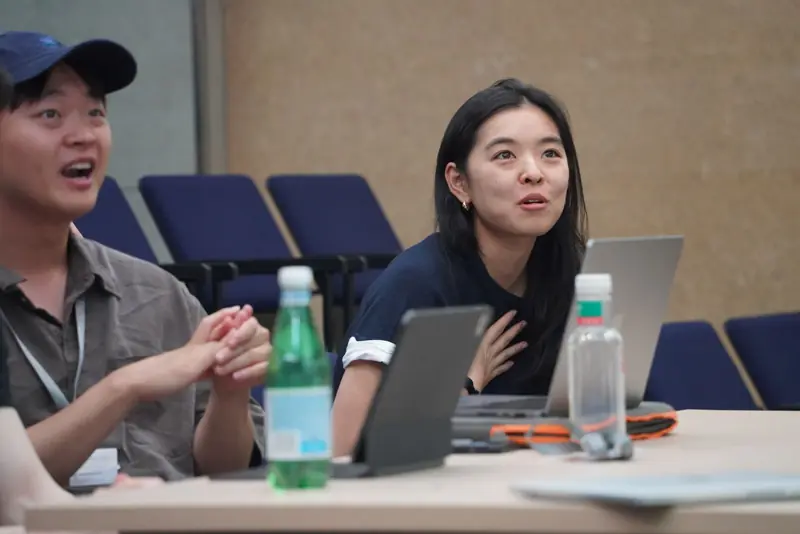
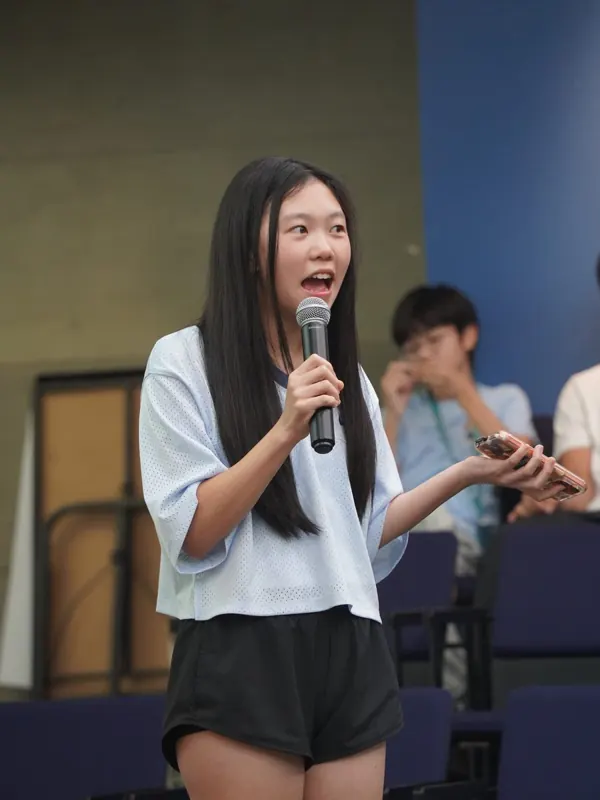
Every week, a mentor holds a 25-minute check-in. Between sessions, the student sends a short written update, and families review progress each term.
Five milestones, the same ladder for every project.
Each student sets a target with their mentor at the start, then moves up the ladder at their own pace, judged on the work, not on attendance.
- 01Launch
A working product, published at a public link. Every project starts here.
- 02Traction
100 users from outside the student’s own circle.
- 03Revenue
First income from people who pay for the product.
- 04Impact
1,000 users, press coverage, or a competition final.
- 05Recognition
A national competition win, or a registered company.
Started in a program, kept going.
- International School of Beijing · After the summer program
Projects that kept going
After the five-day program in summer 2026, alumni continue their projects in the Year-Long Project Mentorship.
- Started
- Summer 2026, five days at ISB
- Now
- Year-Long Project Mentorship
- Bodley Academy · Hong Kong, summer 2025
Twenty students, five days
A five-day course designed and taught by Phillip An. Each student worked on one real problem they chose.
- Students
- 20
- Rating
- 9.5 / 10 Net Promoter Score
 ChatGPT
 Claude
 DeepSeek
 Kimi
 Figma
 GitHub
 Vercel
The student decides what to use, with a mentor checking the result.
- A live productPublished at its own link, with the student’s name and decisions behind it.
- A documented recordMonths of users, numbers, and decisions to describe in an application.
- People who know their workMentors and guest reviewers who watched them build it.
- Experience presenting itPractice explaining the work, in public, to people who ask hard questions.
Our team has walked the same path.
Arena’s team studied at and worked for the institutions students aim for, and teaches from that experience.

In her words
Education is moving from knowing the answer to knowing what’s worth building. That is the skill AI can’t hand a student, and the one we teach.
 Jing Jing YangCo-founder, Arena School
Experience
 Brown UniversityEconomics and Behavioral Decision Sciences
 Microsoft AIAI research
 AppleTechnology
 DeloitteConsulting
 Tsinghua UniversitySchwarzman Scholar
 Kimi · Moonshot AIInternational growth
In his words
AI is changing work quickly. The habits students build now, in class and at home, are what carry over.
 Phillip AnCo-founder, Arena School
Experience
 CaltechComputer Science
 McKinsey & CompanyManagement consulting
 Goldman SachsInvestment banking
 Harvard UniversityMBA and master’s in engineering
 Y CombinatorCo-founded Homebase, the first YC-backed company from Vietnam; Forbes 30 Under 30
- Tsinghua UniversitySchwarzman Scholar
What families ask.
What if my child doesn’t have an idea yet?
That is where most students start. In the first phase, the student and mentor explore problems the student cares about and test which one is worth building.
Does this fit a busy schedule?
Yes. The weekly check-in is 25 minutes, and a written update between sessions takes a few minutes. The program is designed to sit alongside exams, sports, and other commitments.
Does my child need a team, or can they work alone?
Either works. Teams of up to four are encouraged, and students may also work on their own. Students can regroup at the end of a term.
Will this help with college admissions?
No program can promise an admissions outcome, and we do not. What a student gains is a real project with users, results, and decisions they can describe in their own words and show with a link. Each university makes its own decision.
What does it cost?
It depends on the project and the length of mentorship. Tell us about your child and their project idea, and we will confirm details directly within three working days.
Can a student join without a project idea?
Yes. The first phase is choosing and validating the problem with their mentor.
Enroll at any time.
Mentorship starts on a rolling basis. The form takes two minutes, or ask us a question first.
- 01Continuing from ArenaArena alumni
Mentors continue from a student’s earlier Arena project.
- 02Starting freshNew to Arena
The student chooses a project with a mentor, then check-ins begin.
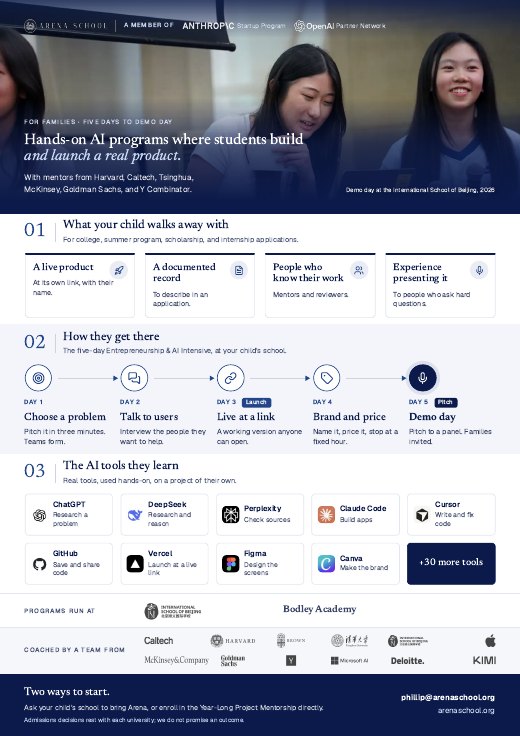
Get the Arena one-pager
Every program and what we have run, on one page.
We will email the one-pager to you within one working day.
Our team has your note and will reply personally within three working days.